
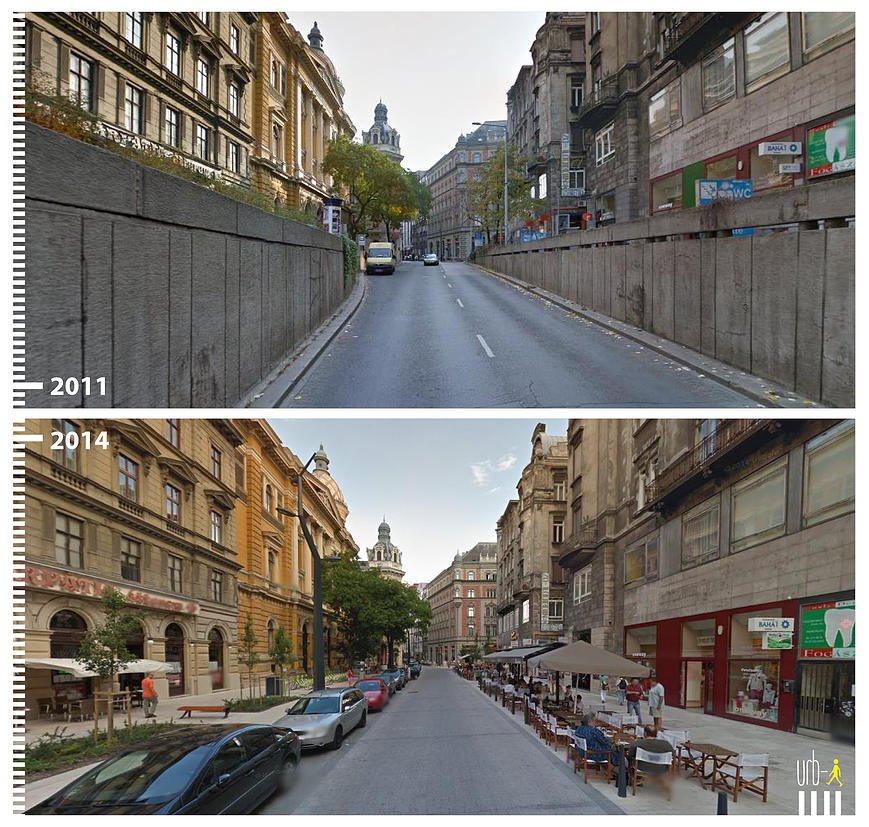
Watch Streets Evolve From Car-Focused to People-Focused

they-keep-tabs-on-urban-transformation-blogs-and-architectural-projects-so-they-know-where-to-check-on-google-street-view

Streets were for people, then cars took over and ruined cities. For the last hundred years cities transformed themselves from walkable places to sprawling buildings which were designed for heavy car use. Now, cities have seen how that’s a mistake.

A design firm, Urb-i, has used Google street view to catalog how cities are making themselves good places to be. Hopefully this trend of making cities human-focused instead of car focused continues!

In São Paulo, Brazil — which boasts over 10 million residents — a third of the people travel by car, another third takes public transit, and another walks. Yet cars take up a majority of the roads and public spaces.

Seeing that, a Brazilian urban planning collective called Urb-i set out to demonstrate that imbalance and show off examples of more people-friendly design. They scoured Google Street View images to find the most stunning public space transformations from around the world. The results give us hope that our cities are becoming more beautiful places to live.

See more.

Sucking Diesel Fuel From Thin Air

We’ve polluted so much that there are now companies that think there is profit to be made by sucking CO2 from the air. How they make money is by reselling the CO2 to make carbonation for soft drinks, or strangely, to make diesel fuel.

What a world!

German company Sunfire produced its first batches of so-called e-diesel in April. Federal Minister of Education and Research, Johanna Wanka, put a few litres in her car, to celebrate.
And the Canadian company Carbon Engineering has just built a pilot plant to suck one to two tonnes of carbon dioxide from the air daily, turning it into 500 litres of diesel.

The process requires electricity, but if the start-ups use renewable electricity they can produce diesel that is carbon neutral.

In other words, burning it in your car only returns to the atmosphere the CO2 removed in the first place.

Read more.

India Drastically Reduces Deaths from Tetanus

India has an amazingly large population and I can only imagine the challenges with delivering health care to that many people. India has it somewhat figure out and they keep getting better at it. Recently the country has reduced the number of deaths from tetanus to an all time low and to a level that makes it essentially a statistical blip.

India has reduced cases to less than one per 1,000 live births, which the W.H.O. considers “elimination as a public health problem.” The country succeeded through a combination of efforts.

In immunization drives, millions of mothers received tetanus shots, which also protect babies for weeks.

Mothers who insisted on giving birth at home, per local tradition, were given kits containing antibacterial soap, a clean plastic sheet, and a sterile scalpel and plastic clamp for cutting and clamping the cord.

Read more.

Rethinking Addiction

Johann Hari wanted to find out why people get addicted to drugs and ended up making some startling conclusions. Yet, not surprisingly, all the war on drugs policies countries have implemented have only increased the addiction problem. Addiction is more complex to solve than just hurting the people who use drugs.

What really causes addiction — to everything from cocaine to smart-phones? And how can we overcome it? Johann Hari has seen our current methods fail firsthand, as he has watched loved ones struggle to manage their addictions. He started to wonder why we treat addicts the way we do — and if there might be a better way. As he shares in this deeply personal talk, his questions took him around the world, and unearthed some surprising and hopeful ways of thinking about an age-old problem.

How To Stop An Oil And Gas Pipeline: The Unist’ot’en Camp Resistance

The Unist’ot’en people have been fighting the deplorable people at TransCanada, Enbridge, and other companies who are trying to increase their capability to destroy the environment. The Unist’ot’en camp began in 2010 and has grown since to blockade the land from corporate tools trying to get pipelines through the area.

Of course, the Canadian (and BC) government supports the corporations but hopefully recent actions in the courts will force the government to back down. In the meantime, you can read about the Unist’ot’en camp.

Our nine-day visit supports the Unist’ot’en Camp practically as well as politically. On our second night in camp, while my fellow visitors shovel snow and build a counter for the kitchen, I go to the frigid Wedzin Kwah to collect water. As I lug heavy plastic jugs full of ice-cold water up the snowy hill to the main cabin, the opportunity feels special, a rarity for a suburban kid like me. I realize I’ve never lived near a stream clear enough to drink from. This strikes me as completely nuts, considering I’ve grown up entirely in the sopping-wet Pacific Northwest.

Bringing water up from the river by hand leads everyone to use water thoughtfully. There are 12 people at the camp, and during my stay, all of our daily cooking, cleaning, and drinking is accomplished with about 40 gallons — a quantity that a showerhead with the EPA’s WaterSense label would run through in 20 minutes.

Read more.