Groovy Bike Helmet Lights Up

The Lumos helmet is designed to make riding a bicycle even safer. In the majority of collisions between automobile drivers and cyclists the car driver is at fault, so to make riding safer the helmet projects bright lights. This means that people who aren’t paying attention to the road as they drive will be forces to acknowledge the presence of the cyclist.

The helmet is a high-tech beauty for a low tech transportation solution. I just bought one.

ALWAYS HAVE A GREAT SET OF LIGHTS WITH YOU
It shouldn’t be difficult or inconvenient to take care of your basic safety as a cyclist.
With Lumos, rest easy knowing you always have a great set of lights on hand.
BRIGHT LIGHTS TO STAND OUT ON THE ROAD
14 super bright white LEDs in the front and 16 super bright red LEDs in the rear provide over 80 lumens of illumination to ensure that you stand out on the road.
Check out the Lumos Helmet.

Light Rail Bringing Massive Change to American Cities

Let’s face it: driving sucks.

Car traffic is bad for everyone and a lot of American cities have caught on to this. As a result, more light rail is being built throughout the USA, recently Pheonix residents voted to back more light rail with a tax hike.

What’s pushing this? It turns out that the awfulness of the commute, more cities adopting good public transit policy, and increased urbanization.

The future of light rail looks bright!

“Light rail” is a broad term that means a passenger rail system with tram-style cars—as opposed to “heavy rail” subways, as in New York and Washington, D.C.—that runs on its own right of way, usually at street level. Light rail cars typically run at 30 to 40 miles per hour at top speed, much less than a heavy rail subway.

In many cities, the building of light rail lines represents only one aspect of broader efforts to solve the public transportation puzzle. Cities are increasingly connecting light rail lines with major nodes of activity and other transportation modes such as expanded express bus services or bike lanes. Phoenix’s light rail connects downtown with Arizona State University in Tempe and Sky Harbor Airport. Charlotte has a light rail system and is now adding a streetcar. Atlanta and Miami have traditional heavy rail transit systems but are investing in other technologies such as streetcars and bus rapid transit. Las Vegas has a monorail along the Strip but is talking about a rail line to the airport.

Read more.

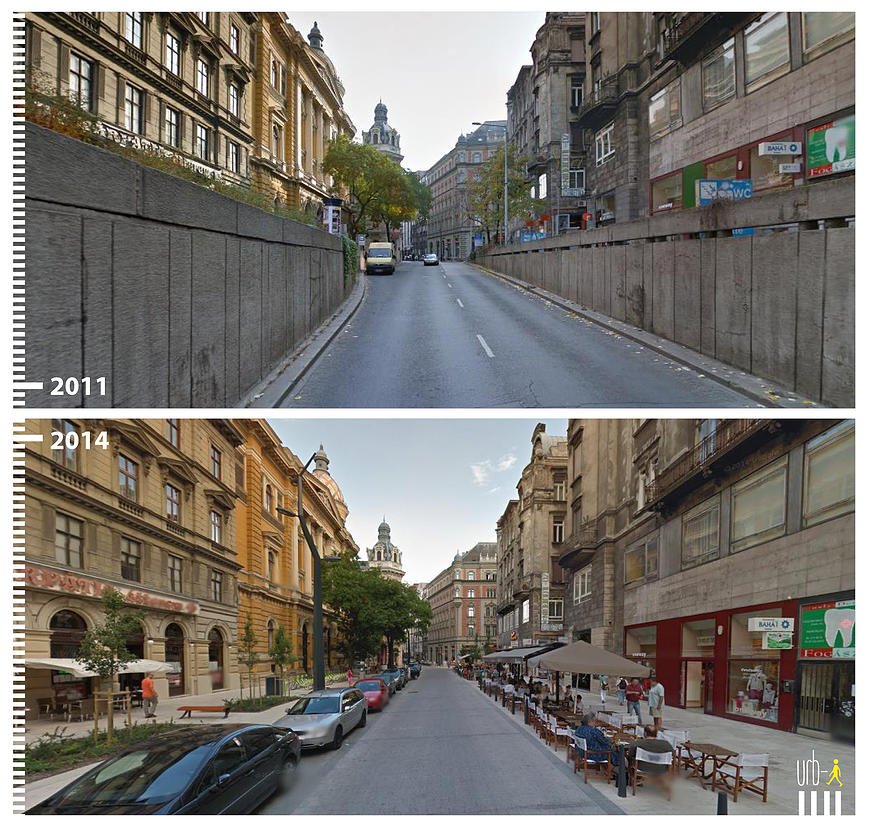
Watch Streets Evolve From Car-Focused to People-Focused

they-keep-tabs-on-urban-transformation-blogs-and-architectural-projects-so-they-know-where-to-check-on-google-street-view

Streets were for people, then cars took over and ruined cities. For the last hundred years cities transformed themselves from walkable places to sprawling buildings which were designed for heavy car use. Now, cities have seen how that’s a mistake.

A design firm, Urb-i, has used Google street view to catalog how cities are making themselves good places to be. Hopefully this trend of making cities human-focused instead of car focused continues!

In São Paulo, Brazil — which boasts over 10 million residents — a third of the people travel by car, another third takes public transit, and another walks. Yet cars take up a majority of the roads and public spaces.

Seeing that, a Brazilian urban planning collective called Urb-i set out to demonstrate that imbalance and show off examples of more people-friendly design. They scoured Google Street View images to find the most stunning public space transformations from around the world. The results give us hope that our cities are becoming more beautiful places to live.

See more.

Commute by Bike to Decrease Your Stress

bike

Stanford University’s Calming Technology Lab has found evidence to support what most commuter cyclists already know: riding a bike to work instead of driving a car lowers one’s stress. Not only are you improving your own mental health you’ll be consuming less gas and save a lot of money while getting physically fit.

There is no better day than today to start riding your bike to work.

“It’s particularly interesting to see that many people don’t transition back into the home after a long day of work very well. By biking to work we know that the physical nature of cycling and physical exertion will engender a more calm and focused state of mind. So while being good for us physically, we also see lots of psychological and emotional benefits.”

Read more.

Infrastructure That Cleans the Air

Barcelona is going to build a road bridge which may be the cleanest bridge yet. Of course it’ll have pedestrian walks and bike paths, however, what makes the bridge really noteworthy is that it will clean the air.

Concrete is notoriously energy-intensive to create so any carbon offset is beneficial. The Barcelona bridge will make use of photocatalytic concrete.

But the real prize of this thing is its basic building material, photocatalytic concrete. The principal of photocatylitics is that ultraviolet light naturally breaks down dirt, both natural and synthetic. It’s that old adage about sunlight being the best disinfectant. Photocatalytic concrete is used with titanium dioxide, which helps accelerate the natural UV-breakdown process, turning the pollution into carbon dioxide, and oxygen and substances that actually belong in the atmosphere.

The actual process has to do with semiconductors and electrons and other things that you may or may not care to read about. (At any rate, the Concrete Society of the United Kingdom does a better job of explaining it.)

An air-cleaning bridge makes for a neat news story and a sci-fi-ish novelty that environmentalists can blog about. But the important point is that Barcelona has taken a piece of infrastructure that exists solely to accommodate car culture, and re-invented it to partially offset the effects of car pollution.

Read more.

Scroll To Top