
The Optimistic Environmentalist


David Boyd is sick of hearing doom and gloom when we talk about the climate and the environment. Sure, we’ve basically ruined this planet but there’s still good news out there and we can talk about the solutions. Indeed, we have the knowledge to save the planet and all we need to do is – do it!

When it comes to news about climate change and the environment, it has to be said that the vast majority of what you hear tends to be full of doom and gloom…our own show included.

In fact, it seems the more attention one pays to the state of the planet, the more hand-wringing and pessimism would be the only suitable reaction.

But David Boyd is here to say that the position of “environmental optimism” is not the oxymoron it may appear to be.
Listen to it here.

Be Healthy by Getting Dirty

Hygiene is harming us. The overuse of antibacterial everything and the kill-all solution of antibiotics seems to be doing harm to us. Don’t get me wrong – we need antibiotics and antibacterial solutions. The thing is that we’ve used them too much.

The good news is you don’t have to be so worried about over-cleaning everything. People, kids in particular, need to have some dirt, germs, and grime around them so their immune system develops.

Most recently, it’s been discover that exposure to certain bacteria can hold back asthma.

To check if the missing bacteria are protective, the researchers inoculated germ-free mice with the FLVR bacteria and found airway inflammation improved in adult offspring of the mice compared with those without the FLVR bacteria.

The findings support the “hygiene hypothesis” of how sterilizing everything may come with a health cost in the long term.

“Maybe we’ve actually cleaned up things too much in our quest to get rid of all these infectious diseases,” Finlay said. “I really do think we have to retool how we behave.”

Read more.

The Slow City, The Good Life

Cities are often associated with the hustle and bustle of life and commerce. Whereas the countryside is associated with stillness and slowness. One author, William Powers, decided to see what life is like when you treat the city as a slow place akin to the countryside.

Just like Thoreau, he wrote a book about it. Unlike Thoreau, Powers actually practiced what he preached.

My favorite sanctuaries: Pier 45’s tip, where the West Side Highway fades to a hum; a back seat in the cathedral of St. John the Divine in late afternoon; the High Line, a new park sanctuary created from unused urban infrastructure; a silent, little-touristed third-floor corner of the Met reached via a concealed stairway in the Asian wing (it houses imaginative Chinese decorative arts).

Moongazing on Tar Beach after dinner, we muse on two other urban sanctuaries: Washington Square and Madison Square Parks on warm days, when we love to kick off sandals and lie back to savor that sensual press of our bodies to the Earth. Gravity’s eros. I can feel that attraction now — and it’s mutual, since our bodies exert a tiny gravity on the Earth — as my wife and I touch hands, the Milky Way invisible against Manhattan’s illumination, with only Venus, the moon, and a handful of stars perforating through.

Keep reading.
Get the book.

A Virtual Companion for a Safe Walk Home

At the schools I teach at they each have a volunteer run service to help people walk home who are worried for their safety. When one graduates from these schools they are on their own. Seeing that this how walk-safe programs work a bunch of students have created an app to help people feel safe on their walks.

The students’ Companion app, which recently came out in a new version, is simple to use. You type in the address you’re headed to, pull down a map, and then pick a friend or two from your list of contacts. They don’t have to have the app to help; a text message with a link to a map will pop up on their phone.

“If the user goes off route, or doesn’t make it to the destination on time, or if they fall, or are pushed, or are running, or even if their headphones are pulled out of their phone, all of their emergency contacts are notified,” says Ernst. “It’s a good way to keep in touch with the people around you and stay safe. And give you peace of mind.”

Read more.

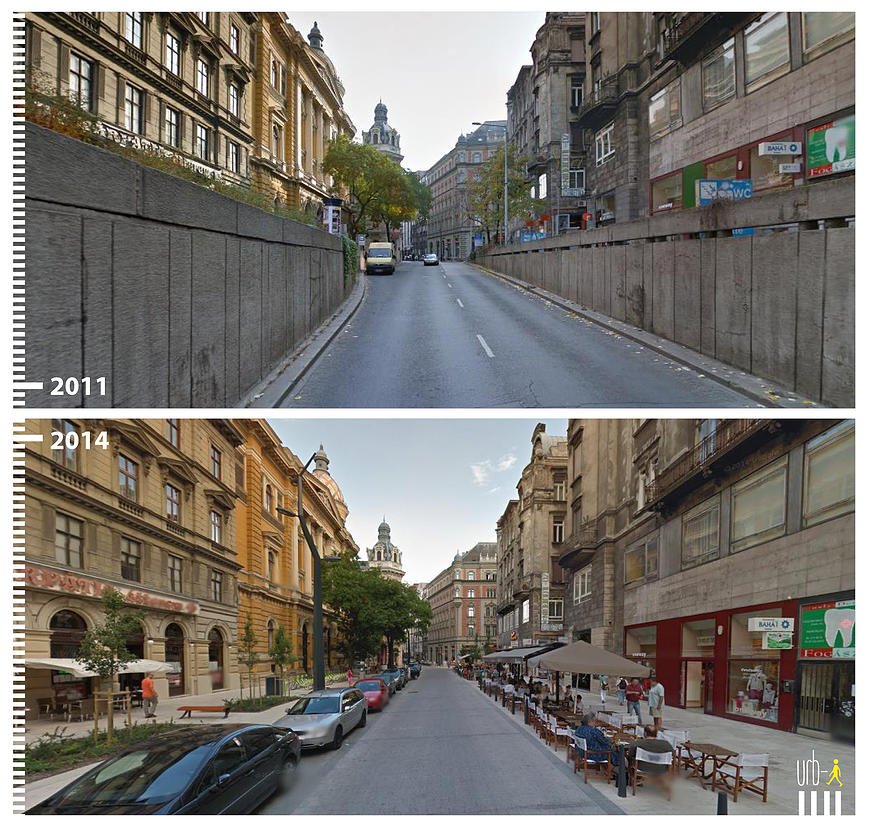
Watch Streets Evolve From Car-Focused to People-Focused

they-keep-tabs-on-urban-transformation-blogs-and-architectural-projects-so-they-know-where-to-check-on-google-street-view

Streets were for people, then cars took over and ruined cities. For the last hundred years cities transformed themselves from walkable places to sprawling buildings which were designed for heavy car use. Now, cities have seen how that’s a mistake.

A design firm, Urb-i, has used Google street view to catalog how cities are making themselves good places to be. Hopefully this trend of making cities human-focused instead of car focused continues!

In São Paulo, Brazil — which boasts over 10 million residents — a third of the people travel by car, another third takes public transit, and another walks. Yet cars take up a majority of the roads and public spaces.

Seeing that, a Brazilian urban planning collective called Urb-i set out to demonstrate that imbalance and show off examples of more people-friendly design. They scoured Google Street View images to find the most stunning public space transformations from around the world. The results give us hope that our cities are becoming more beautiful places to live.

See more.