
MIT is currently wanting to give a modern voice box to those living in countries where technology is luxury. MIT has a question and answer page set up, and it will probably answer all your questions.
It Speaks to ALL of You!
New Scientist is reporting that a computer program can learn languages. Feed the program text and it will analyze from a mathematical standpoint and be able to form sentences in the learnt languages. Are closer to a device from Star Trek known as the Universal Translator?
Hydristor: Believe the Hype?
Inventor Thomas Kasmer has made a neat little device called the Hydristor, which, according to him, has the potential to change the world. 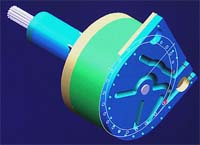
The Hydristor belongs in your car, it basically replaces the transmission. In all transmissions energy is lost, a automatic car has worse mileage than a manual car because an automatic transmission consumes more power. What makes the Hydristor more efficent is how it transfers the power to the drive train and how it absorbs power from braking forces that can later be used to power the vehicle.
The heavier the vehicle the more power the Hydristor can get from braking. As a result the feul efficency of all vehicals can improve, espically heavier vehicles like SUVs.
“In theory, it should work. The biggest advantage of his system is that it’s very small and compact. I don’t think I’ve seen a variable transmission as small and as simple as this.” This quote is from a good article on the Hydristor at PressConnects.com
Russian Sub Crew Rescued
The Russian mini-submarine that was trapped in a fishing net 190 meters below the Pacific has now been rescued. All members of the seven member crew are alive.
A British robotic submarine cut the Russian mini-sub free of the fishnet that it was stuck in. Moscow had asked for help from America, Britian, and Japan. All three responded quickly with the British able to airlift their robotic sub to a nearby Russian naval base the fastest. From the base a Russian boat took the British sub out to sea.
Toronto Transit Experiment
The Toronto Transit Commission is starting an interesting experiment on it’s St. Clair street car line: the Time Based Transfer. Transfers on the line are now valid for up to two hours after you disembark the vehicle, and will allow you to board any other TTC route, including the one you just departed. See a trendy cafe from the window? Need to do some shopping? Now you can do it all on one ride.
This seems like a good way to encourage people to use Transit for their non-commuter needs. If successful, the word is that these transfers will be expanded to the entire network.